England & the Rhineland, 16th–17th c.
The Fourth Key
A skeleton stands upright on a shrouded coffin between a burning candle and a dead tree stump.
- Work
- The Twelve Keys of Basil Valentine, in Musaeum Hermeticum (1678 edition, Frankfurt)
- Artist / creator
- Matthaeus Merian the Elder, engraver (text attributed to Basilius Valentinus)
- Origin & date
- Late 17th century (1678 edition); text tradition traced to ca. 1599
- Held by
- Science History Institute, Philadelphia
Format
The full-resolution color-managed file — yours to print, study, and keep.
Size
Available as a digital download only — this scan’s resolution doesn’t hold up cleanly as a physical print at any size.
$24.00
The story
A skeleton stands on a draped box or bier in an open landscape, a lit candle burning to its left, a bare tree stump to its right, a church visible in the distance. Practitioners read this as the blackening stage of the Work, putrefaction, in which the starting matter was understood to "die," reduced to an inert residue as a necessary prelude to purification and eventual rebirth inside the vessel. The candle mattered: it signaled that this decay was believed to proceed under a gentle, sustained heat rather than violent fire. Set against the standard memento-mori skeleton, that single flame is the detail worth lingering on, a visual restatement of the alchemical maxim that nothing new is made without the death of what came before. Among the twelve, this plate is often singled out as the sequence’s starkest image of that stage.
About this reproduction
- Faithful reproduction of a public-domain work, sourced from Science History Institute, Philadelphia’s open-access release.
- Printed to order on archival cotton-rag stock, pigment inks rated 100+ years.
- Color-managed to the source scan.
- Ships in 5–8 business days; satisfaction guaranteed.
More from Hermetic Diagrams & Scrolls

Ripley Scroll — Beinecke Mellon MS 41
Beinecke Rare Book & Manuscript Library, Yale University

Ripley Scroll — Getty Research Institute, 950053
Getty Research Institute — Manly Palmer Hall Collection of Alchemical Manuscripts

Ripley Scroll — Huntington Library, mssHM 30313
The Huntington Library, Art Museum, and Botanical Gardens
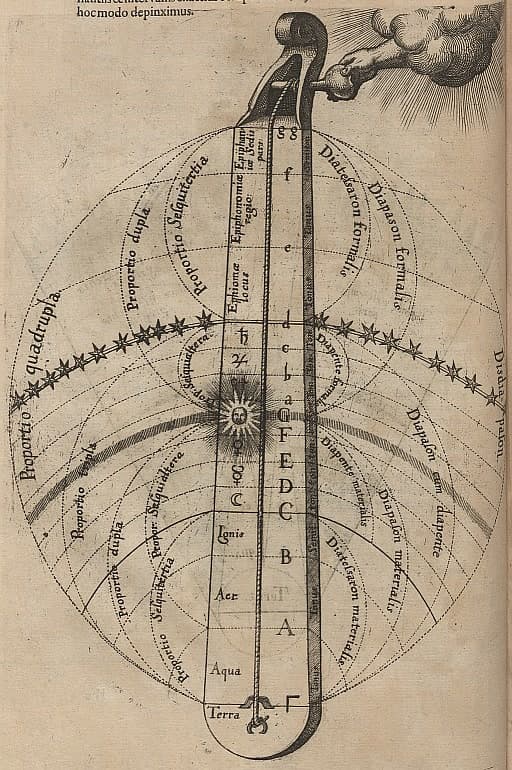
The Divine Monochord
Deutsche Fotothek, Saxon State and University Library Dresden (SLUB)