Frankfurt, 1550 (this selection also draws on a 1610 Basel reprint)
Extraction of the Soul
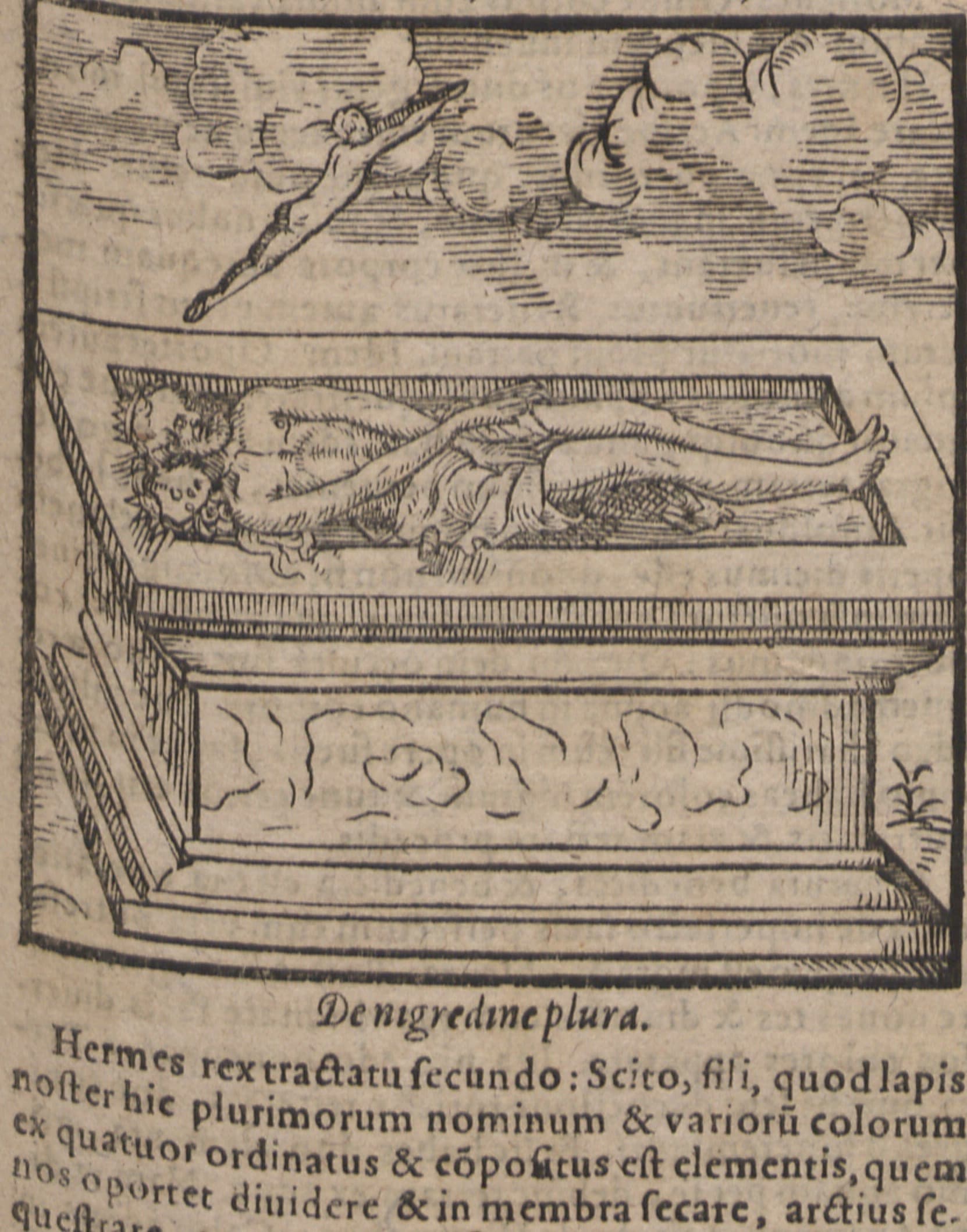
A small winged figure launches from the tomb into the clouds — the soul departing the dead, fused body below.
- Work
- Rosarium Philosophorum
- Artist / creator
- Unknown (anonymous woodcut artist)
- Origin & date
- Text first printed Frankfurt, 1550; this scan is the 1610 Basel reprint (Artis Auriferae, quam chemiam vocant)
- Held by
- SLUB Dresden (Saxon State and University Library)
Format
The full-resolution color-managed file — yours to print, study, and keep.
Size
Sized to protect print quality — this scan’s resolution supports sizes up to 8x10 cleanly.
$24.00
The story
A tiny nude figure, wings spread, streaks upward out of the same coffin shown in the preceding plate, leaving the double-bodied corpse behind. The German caption reads: "Here the four elements divide themselves; from one body the soul quickly departs." Alchemists described this stage as the separation of a substance into its constituent principles — earth, water, air, and fire — with a volatile "soul" driven off by gentle heat while the heavier "body" remained in the vessel. It was treated as a necessary, if unsettling, midpoint: nothing could be purified or reunited until the substance had first been taken fully apart. The soul’s small scale against the open sky, still visually tethered to the tomb beneath it by the plate’s composition, keeps departure and the body left behind legible within a single image.
About this reproduction
- Faithful reproduction of a public-domain work, sourced from SLUB Dresden (Saxon State and University Library)’s open-access release.
- Printed to order on archival cotton-rag stock, pigment inks rated 100+ years.
- Color-managed to the source scan.
- Ships in 5–8 business days; satisfaction guaranteed.
Image courtesy of SLUB Dresden (Saxon State and University Library), Public Domain Mark 1.0.
In situ
See it framed
Extraction of the Soul composited into real, photographed rooms — choose the room and the frame, see exactly what arrives.
Shown at 8x10" — the largest size this piece’s scan holds full clarity at.